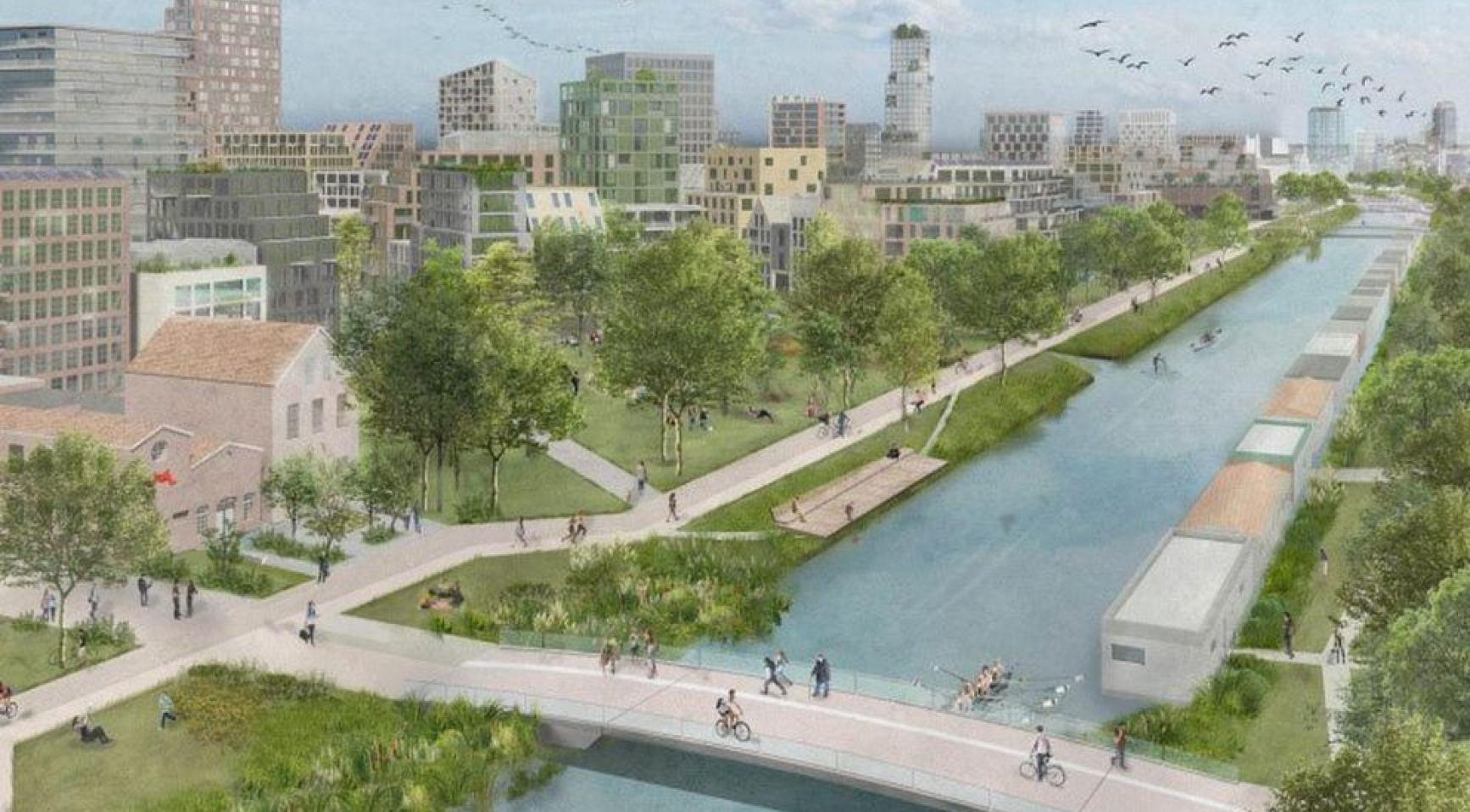
I live in Utrecht… I sometimes see how it is in car-centric countries. It really is a relief to come back home. I don’t even have a driver’s license, I use my (folding) bicycle+public transport for everything.
Utrecht was one of my favourite cities when I visited (Zwolle was also beautiful). It was amazing to see an entire country that’s focused on avoiding car dependence 💜
Well… Not quite, unfortunately. A heavily car-centric right-wing party has been the ruling party here for decades now. Fortunately, they know trying to get rid of our bicycle culture would be bad for votes.
I would like to take this moment to express my profound, yet jaded, jealousy.
How did this come about? Do you just have good local politicians or is there another ingredient?
I think there’s many contributing factors, local politicians being only one of them.
The Netherlands is a near perfect country for bicycling. The country is flat, very flat, borderline level. The moderare, marine climate helps too, you won’t often arrive sweaty or completely frozen, the common rainfall is a downside though. It’s also a small country with a high population density. This means the next village/town/city over is often less than 30 minutes biking away. Almost everything that matters in day to day life can be within such a distance for the vast majority of the population and has been for the past hundred years.
This brings me to the historical aspect. I’m no historian and I’m making some educated guesses here. Bicycles have been popular in The Netherlands pretty much since their introduction. They became commonplace in a time where cars were really only for the elite while the price of a bicycle was managable for the working class even before WW2 (then the nazis stole many many bikes during the war). After the war, resources were scarce, so once again bicycles were a sensible option.
The ANWB, the Dutch cyclists association has existed since well before WW2 (founded in 1883), but entered the car space shortly after the war in the form of roadside assistance. They have been (and still are) a major player in promoting both cycling and car infrastructure. They provided the highway signage until as late as 2004. I have no doubt that the ANWB is one of the reasons that the car lobby didn’t become as excessive as in many other countries.
Another piece of the puzzle is the nature of Dutch infrastructure planning. It is quite pragmatic but not very rigid. There’s a guideline published by the ministry of infrastructure (whatever the real name may be). This handbook is written and updated by infrastructure specialists, not by politicians and its contents are based on research and data. Research has repeatedly shown that has repeatedly shown that (among other things) bicycle infrastructure is greatly beneficial to (Dutch) cities and also shows how to build such infrastructure with traveler’s safety in mind. Politics only comes into play once it comes to planning specific roads etc. At this point it is the default to follow the guidebook (including the bicycle infrastructure) and only deviate if the situation requires it. I.e. bicycle infrastructure is the default in the system.
Finally, the specific situation of Utrecht comes down to local politicians. A car free neighbourhood is a deviation from the standard recipe, but one that fits in general recent trends. This case mostly jumps out in scale, but not by much. 12 000 people sounds like a lot, but in the context of high density apartment complexes it’s not that big of an area. I don’t know the specific plans, but I expect a tram/bus stop right in the middle of the area and car parking within a 5 minute walk for everyone. Pretty cool though, sounds like a nice neighbourhood to live in once it’s finished.
Thanks for writing all this! I have to mention that @notjustbikes@notjustbikes.com argues that weather is not (or should not?) be a big factor in infrastructure choices around bicycles, though:
Thanks for the comprehensive answer. I agree, it’s very cool and I hope other places can copy despite not having the same culture and background as the Dutch.
I’m not sure! It’s not just Utrecht, the Netherlands as a whole has arguably the best bicycle infrastructure in the world.
There is a very successful “Fietsersbond” (bicyclists’ union) that’s been around since the fifties, I believe, which probably helped. And the country is very flat, though that shouldn’t be an excuse for cities.
I suppose in the past we must’ve had quite progressive governments, too. Though these days the biggest centre-right party would rather form a coalition with nazis than anything left-wing…
Can ambulances get through?
In NL emergency vehicles are allowed to drive on bike paths and bus lanes, so yes.
I’d like to live in a car-free neighborhood.
So say, we all.
Oh god, another reason to move to the Netherlands. I can’t explain the deep longing I feel for such an existence.
Utrecht to start construction on largest cat-free neighborhood in the country next week
I was very confused when I read it.
They meant free-cat neighborhood. Take one, they’re free.
Love that place
It mentions public transit options too. Hopefully that’ll include trams and/or metro services for very long distance connections.
It is right on an existing bus line, less than 1km from an existing tram line, and about 2km from Utrecht Centraal.
Honest questions. In these neighborhoods are lorries permitted to drive certain areas? Are all deliveries by bicycle wagon or similar? How do tradespeople bring tools/equipment. How is building/remodeling handled in areas that have little to no vehicle access and heavy equipment needs to be used?
I ask because I’ve lived my entire life in car-centric Midwest U.S. I have traveled in Europe but have not lived there, and so the day to day logistics are a mystery to me. Please help me cure my ignorance <3
From the official website of Utrecht: https://www.utrecht.nl/nieuws/nieuwsbericht-gemeente-utrecht/bouw-grootste-autovrije-stadswijk-van-nederland-merwede-van-start And a different nl website: https://www.managementsite.nl/de-laatste-meter/merwede-wijk-in-utrecht-wordt-autovrij-hoe-moet-dat-met-logistiek
On the edge there are parking spaces and logistical hubs with cabinets to send and receive packets. As well as delivery points for lorries.
Inside however, deliveries are done using cargo-bikes, delivery-robots and small electrical vehicles.
Exceptions are still possible, like for emergencies, trash collection, construction, maintenance and moving vans.
The Goupil G4 is a 120cm wide mini-truck that PicNic uses for grocery delivery across the country, it’s perfect for places like Merwede (and many other cities).
You usually need to get a permit beforehand, except emergency vehicles. These areas are large enough to accommodate them, but the spaces are planned for people, not just cars. If by lorry you mean an 18 wheeler, I don’t think it can maneuver there, it’s usually smaller trucks being used.
For Merwede specifically, ebikes and small electric vehicles are allowed (up to 1,3m wide). If you need to build/remodel/move in or out, you request an exemption with the council. You won’t be able to park anywhere, there will be designated areas for it close to your destination
Having that in mind, tradespeople don’t need huge pick up trucks, you will likely see them using a van or cargo bikes like this one:

There are several grocery services that operate light electric Goupil G4 “mini lorries” which are basically the perfect vehicle to use there.
For anything bigger, you need a permit.
I think there will still be streets, but they will mostly be used as pedestrian areas except for when needed by construction vehicles, trash collection etc
I’m sold! what does it take for someone to move there? I will do anything, sigh…
At least 350k for an apartment. And a European passport or residence permit.
Jeez that’s too much! What about a loan and a European passport?
I mean, none of us here in the Netherlands buy houses without a mortgage either. So yes. That works.