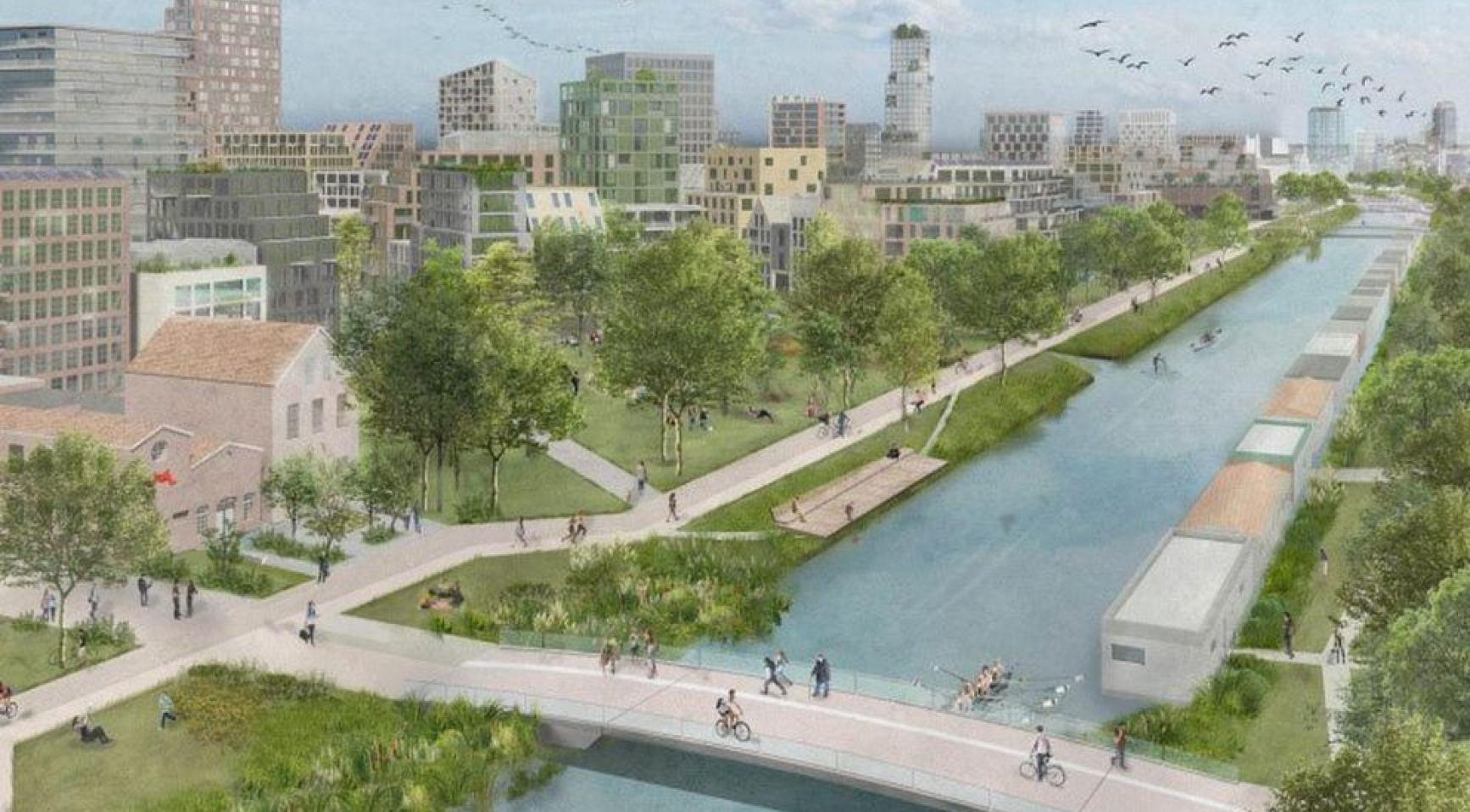
Construction of a new neighborhood is set to begin in Utrecht next week. The neighborhood, called Merwede, is scheduled to be the largest car-free district in the Netherlands, with 6,000 homes. The area will be between the Merwedekanaal and Park Transwijk, in the southwestern part of the city, and will be able to house an estimated 12,000 people.The area consists of 1,800 social rental homes, 1,500 mid-range rental and affordable owner-occupied homes, and 2,700 private sector rental and owner-occupied homes, according to the municipality.


How did this come about? Do you just have good local politicians or is there another ingredient?
I think there’s many contributing factors, local politicians being only one of them.
The Netherlands is a near perfect country for bicycling. The country is flat, very flat, borderline level. The moderare, marine climate helps too, you won’t often arrive sweaty or completely frozen, the common rainfall is a downside though. It’s also a small country with a high population density. This means the next village/town/city over is often less than 30 minutes biking away. Almost everything that matters in day to day life can be within such a distance for the vast majority of the population and has been for the past hundred years.
This brings me to the historical aspect. I’m no historian and I’m making some educated guesses here. Bicycles have been popular in The Netherlands pretty much since their introduction. They became commonplace in a time where cars were really only for the elite while the price of a bicycle was managable for the working class even before WW2 (then the nazis stole many many bikes during the war). After the war, resources were scarce, so once again bicycles were a sensible option.
The ANWB, the Dutch cyclists association has existed since well before WW2 (founded in 1883), but entered the car space shortly after the war in the form of roadside assistance. They have been (and still are) a major player in promoting both cycling and car infrastructure. They provided the highway signage until as late as 2004. I have no doubt that the ANWB is one of the reasons that the car lobby didn’t become as excessive as in many other countries.
Another piece of the puzzle is the nature of Dutch infrastructure planning. It is quite pragmatic but not very rigid. There’s a guideline published by the ministry of infrastructure (whatever the real name may be). This handbook is written and updated by infrastructure specialists, not by politicians and its contents are based on research and data. Research has repeatedly shown that has repeatedly shown that (among other things) bicycle infrastructure is greatly beneficial to (Dutch) cities and also shows how to build such infrastructure with traveler’s safety in mind. Politics only comes into play once it comes to planning specific roads etc. At this point it is the default to follow the guidebook (including the bicycle infrastructure) and only deviate if the situation requires it. I.e. bicycle infrastructure is the default in the system.
Finally, the specific situation of Utrecht comes down to local politicians. A car free neighbourhood is a deviation from the standard recipe, but one that fits in general recent trends. This case mostly jumps out in scale, but not by much. 12 000 people sounds like a lot, but in the context of high density apartment complexes it’s not that big of an area. I don’t know the specific plans, but I expect a tram/bus stop right in the middle of the area and car parking within a 5 minute walk for everyone. Pretty cool though, sounds like a nice neighbourhood to live in once it’s finished.
Thanks for writing all this! I have to mention that @notjustbikes@notjustbikes.com argues that weather is not (or should not?) be a big factor in infrastructure choices around bicycles, though:
https://www.youtube.com/watch?v=BXDP9WQe0io&t=0
Thanks for the comprehensive answer. I agree, it’s very cool and I hope other places can copy despite not having the same culture and background as the Dutch.
I’m not sure! It’s not just Utrecht, the Netherlands as a whole has arguably the best bicycle infrastructure in the world.
There is a very successful “Fietsersbond” (bicyclists’ union) that’s been around since the fifties, I believe, which probably helped. And the country is very flat, though that shouldn’t be an excuse for cities.
I suppose in the past we must’ve had quite progressive governments, too. Though these days the biggest centre-right party would rather form a coalition with nazis than anything left-wing…