

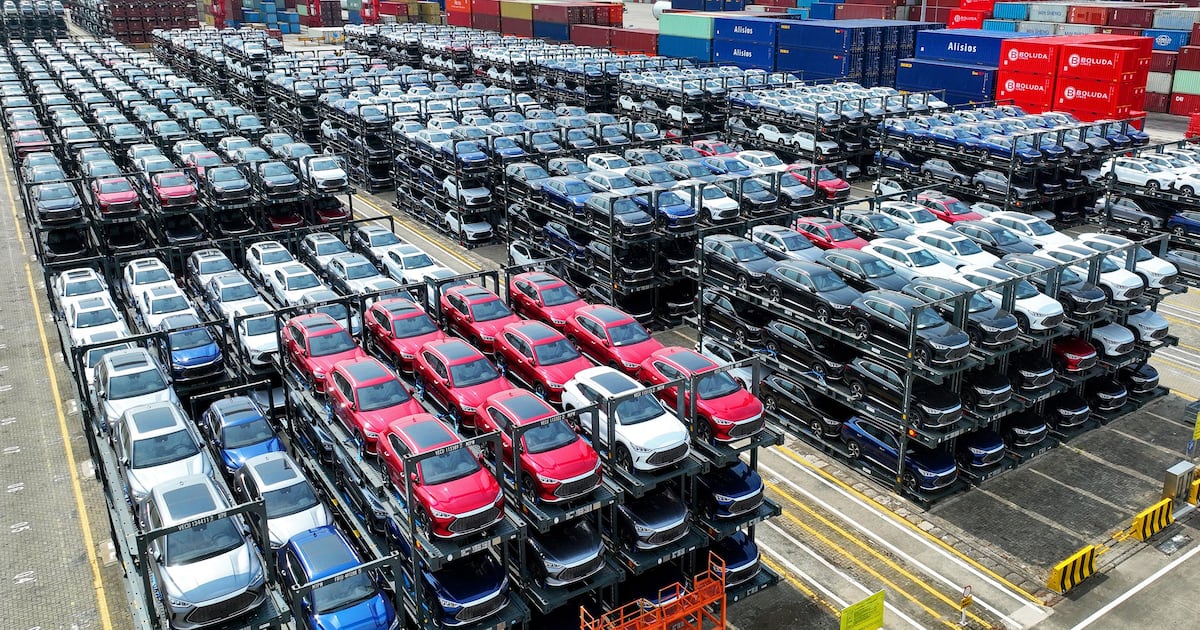
“We’re talking about losing significant parts of the automotive sector and its supply chains, pressure on machine tools, chemicals, the wind industry in Europe that could be wiped out in the next couple of years. I think there’s just more and more concern about the fact that in all of these sectors, China is moving into a dominant or even monopolistic position,” says Andrew Small, director of the Asia programme at the European Council of Foreign Relations (ECFR) in Berlin.
Some in Brussels thought Trump’s return to the White House could help to facilitate a reset in the EU-China relationship. But while Europe’s reliance on the US for security meant that the EU had to roll over when Trump threatened tariffs, China refused to bend, and its tough strategy has so far been successful.
“I think what became clear from the Chinese end was that the view would rather be that Europe is in a weaker position as a result of the situation in the transatlantic ties, and Europe needs to be the one to give things up. That’s what we’ve seen pretty much since then,” says Small.
China’s dominant position in some manufacturing sectors offers leverage of its own, as the Dutch government discovered last September when it seized control of Nexperia, a Chinese-owned chip manufacturer. Beijing retaliated by blocking exports of Nexperia chips
When Japan entered the Western car market in the 60’s and 70’s, it was disruptive too. Especially in USA where it was made worse by the oil crisis, because American cars were giant gas guzzlers, and Japanese cars were the most fuel efficient.
Now China is entering the market, but compared to Japan, China has a 10 times bigger home market to draw from, which is a huge benefit for Chinese manufacturers in several ways.
First it helps manufacturers build large scale production for higher efficiency. Second it helps pay development of new models as cost is distributed on more cars, making it cheaper per car.
Third it allows China to experiment more, as new models that would be minor niche cars in other countries, can sell at scale.
Combined this has resulted in a development pace in China which is about three times faster than what we see in the rest of the world!
So it is no wonder that Chinese cars are gaining market share in the world outside China too. And we can expect the disruption to be bigger than when the Japanese cars arrived in the west.
But there are also a factor of diminishing returns, where scale and development speed will not yield as much benefits beyond a certain threshold.
So the Chinese advantage is probably at its peak right now, and manufacturers that can keep up with the Chinese competition for the next few years will have a good chance of making it in the future.
There’s another important factor complicating things for Chinese companies:
China has copied every peace of technology they could get a hold of in the last 40 years (a smart move to close the gap between the leading nations and yourself in every sector). However, as Chinese industries now have reached the current state of the art and plan on overtaking the competition by making new innovations this leads to a problem: You hardly can dominate global markets while gatekeeping your technology. So China is now faced with the ironic problem of either protecting its innovations or exporting them to the world because it’s not likely that any Western authority will give two shits about protecting Chinese intellectual property and/or patents when China itself didn’t care for the last decades.
Same as every other country since farming was invented.
Yes and no… there used to be something like patent protection and copyrights which, in my eyes, promoted innovation since you were ensured to be able to make use of your ideas.
There is no evidence of that.
There is for developed economies.
https://link.springer.com/article/10.1057/palgrave.jibs.8400306
Bullshit.
There is nothing in that link that shows that patents increase innovation, are you claiming beer is better because of patents?
If you are, that would be like claiming cookies you buy are better than home baked, because bought cookies make use of many patents.
I hope you can see the idiocy of the claim.
No “innovations” happened because they were patentable. But patents happen because they can prevent competition.
And on the other hand evidence that patents stifle competition is pretty clear, and stifled competition decreases innovation.
Steve Balmer expressed it very well IMO, when he claimed Microsoft was a very innovative company because they had created several new types of licenses!
Patents are a disease not a solution.
Point 13 explains this to some degree:
Clearly showing the authors are aware that patents harm competition, and if patents had been introduced earlier, a few companies could have taken over the market and kept competition out.
They are however completely wrong about the “timing” of patents, there is no good timing of patents. Patents will always be harmful after the fact.
I think I get the point and when thinking about it I guess you’re right. Thank you.